

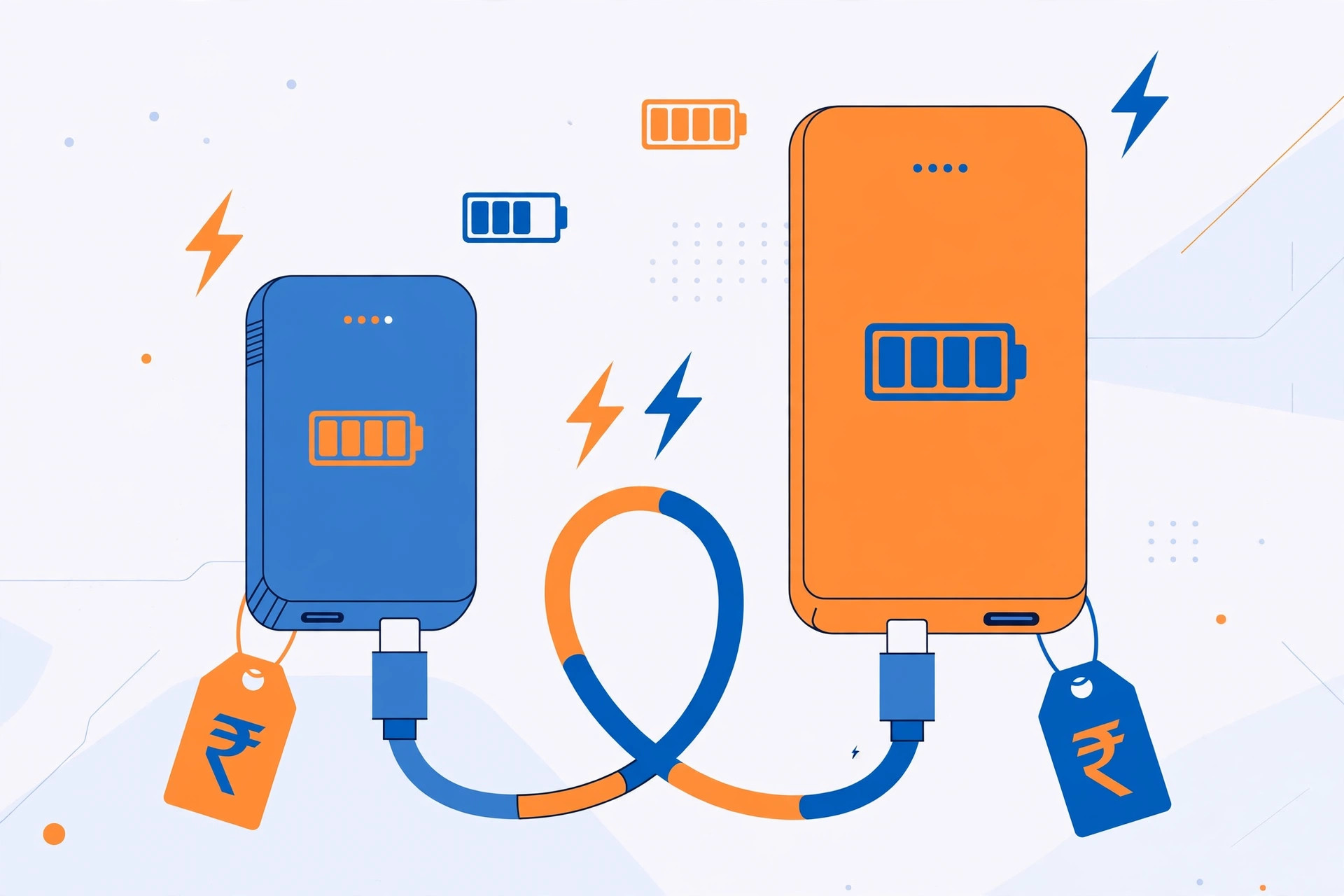
A dead phone battery always strikes at the worst moment: halfway through navigation in an unfamiliar city, on a long train journey with hours still to go, or during a power cut when you need your phone as a torch and a hotspot. For most Indians, a power bank is no longer an accessory. It is essential backup.
The problem is choice. Flipkart and Amazon list hundreds of power banks under ₹2,000, with confusing claims about capacity, wattage and “fast charging”. Many deliver far less than the box promises. This guide cuts through the noise: what actually matters when buying a power bank in India in 2026, which models are worth your money, and how to avoid the common traps.
What to Look for in a Power Bank
1. Real capacity, not just the printed number. A 10000mAh power bank will charge a typical 5000mAh phone roughly 1.5 to 2 times, not twice, because of conversion losses and the phone’s own efficiency. A 20000mAh unit gives you 3 to 4 full charges. For daily commuting, 10000mAh is enough and much lighter. For travel, weekends away, or charging two devices, pick 20000mAh.
2. Charging speed and protocol matching. The wattage number (18W, 22.5W, 33W) only helps if your phone speaks the same fast-charging language. Xiaomi phones use Mi Turbo Charge, Realme and OnePlus use SuperVOOC, Samsung uses PPS-based Super Fast Charging. A 22.5W power bank that supports your phone’s protocol will charge noticeably faster than a “33W” unit that falls back to basic 10W charging with your device. Check the supported protocols in the spec sheet, not just the big wattage number on the box.
3. Ports: USB-C is now essential. In 2026 there is no reason to buy a power bank without two-way USB-C (it both charges the power bank and charges your phone). Look for at least one USB-C port plus one USB-A port, so you can charge two devices at once. Avoid models that still charge themselves only through micro-USB.
4. Safety certifications. Power banks sold in India must carry BIS certification. It is the single most important trust signal: it means the battery cells and circuitry passed Indian safety standards. Never buy an uncertified power bank, however cheap. Good models also list overcharge, over-discharge, short-circuit and temperature protection.
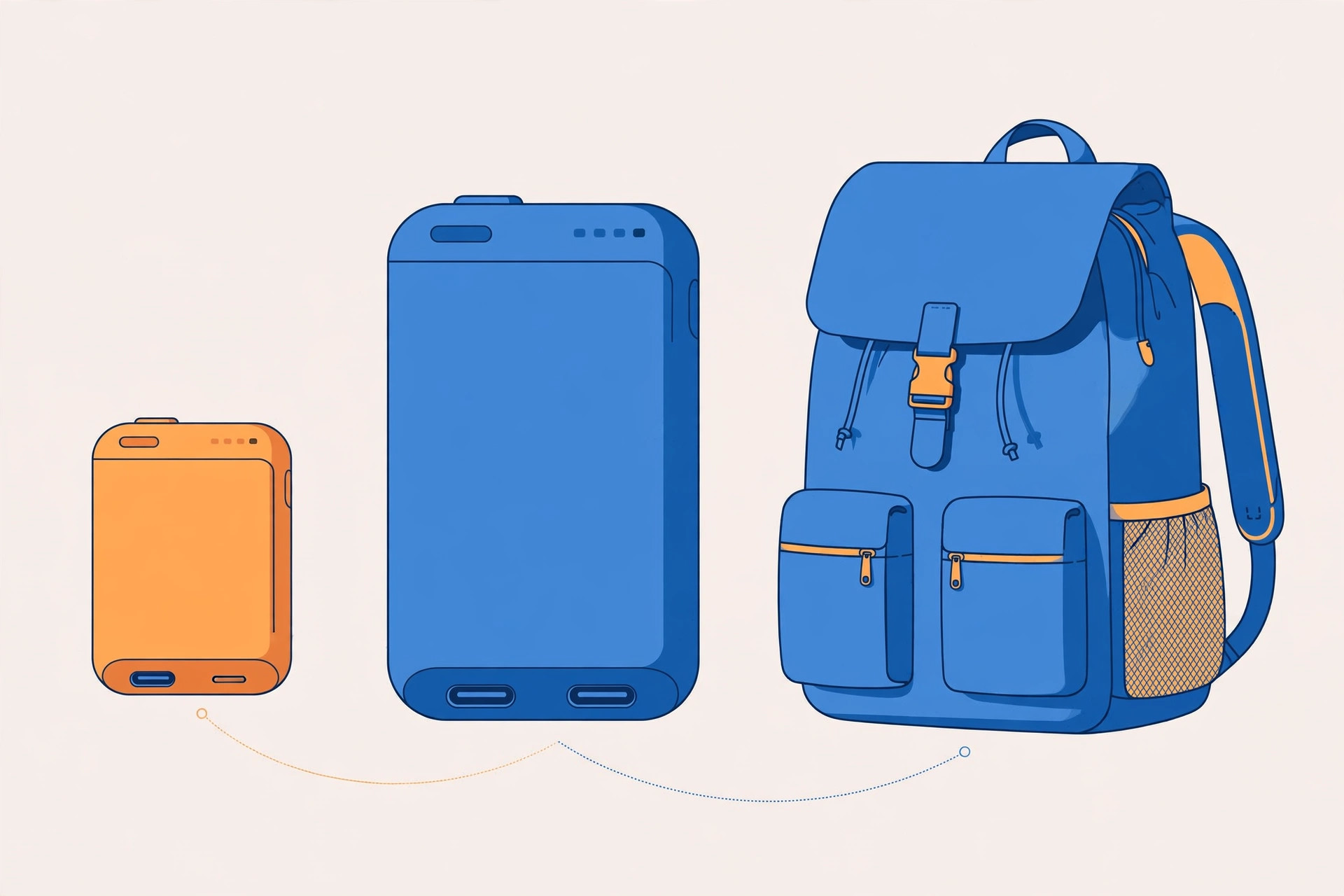
5. Size and weight. A 20000mAh power bank typically weighs 350 to 450 grams, roughly the weight of two phones. That is fine in a backpack but annoying in a pocket. 10000mAh models sit around 200 grams and disappear into a jacket pocket. Buy the capacity you will actually carry.
6. Brand, warranty and service. Stick to established brands with Indian service networks: Mi, Realme, Ambrane, URBN, Portronics and Anker all honour warranties locally. A 6 to 12 month warranty is standard. Random no-name brands may quote inflated capacities and vanish when something goes wrong.
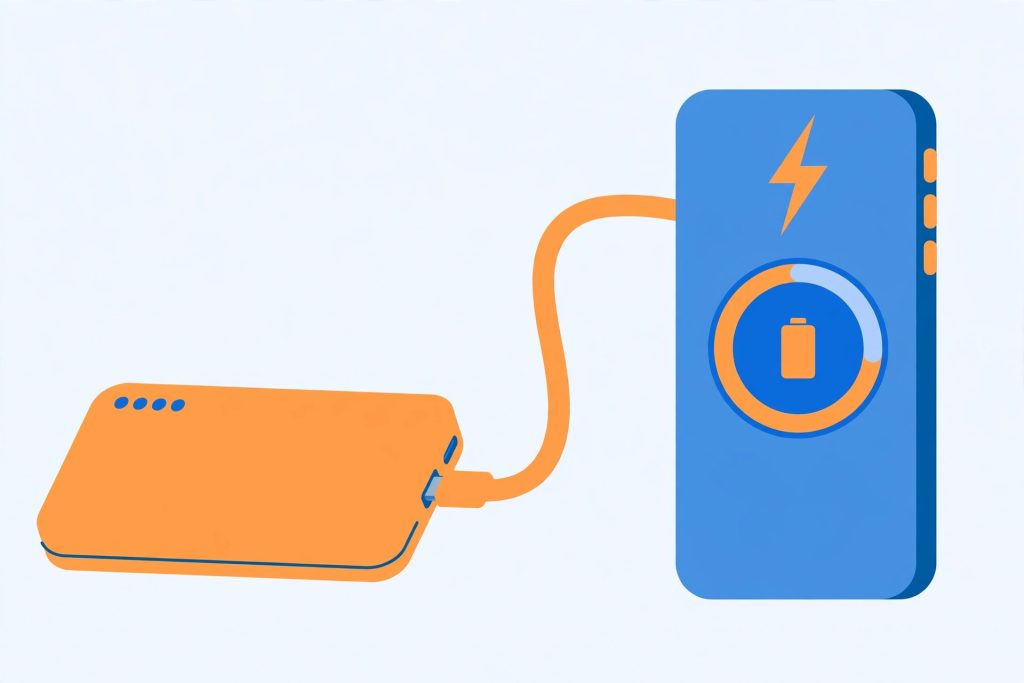
The Top Picks
1. Mi Power Bank 3i 20000mAh (or current Mi 20000mAh model)
Xiaomi’s 20000mAh power bank remains the default recommendation for a reason: honest capacity, 18W two-way fast charging, dual USB-A plus USB-C output, and BIS certification, usually priced around ₹1,800 to ₹2,000. It is a brick, but a dependable one.
Best for: Travellers and anyone who wants maximum backup per rupee.
2. Realme 20000mAh Power Bank (or current Realme 33W model)
Realme’s 20000mAh unit targets Realme, OnePlus and Oppo phone owners with 33W SuperVOOC-compatible fast charging, which genuinely tops up supported phones much faster than generic 18W units. Expect to pay around ₹1,900 to ₹2,200 (it dips under ₹2,000 in sales).
Best for: Realme, OnePlus and Oppo users who want the fastest possible top-ups.
3. URBN 20000mAh 22.5W Power Bank
URBN has built a strong reputation in India for well-built charging gear. Its 20000mAh 22.5W model offers fast two-way charging, a digital battery-percentage display (far more useful than four vague LED dots), and solid build quality around ₹1,700 to ₹1,900.
Best for: Buyers who want a premium feel and an accurate charge display without crossing ₹2,000.
4. Ambrane 10000mAh Mini Power Bank
If you want something pocketable, Ambrane’s compact 10000mAh models with 22.5W fast charging are hard to beat at around ₹1,200 to ₹1,500. An Indian brand with wide service reach, BIS certified, and small enough to carry every day.
Best for: Daily commuters who want light, pocketable backup for one full phone charge.
5. Portronics Power Brick 20000mAh
Portronics regularly undercuts the big brands while keeping BIS certification and 22.5W fast charging. Its 20000mAh Power Brick series often sells around ₹1,500 to ₹1,700, making it one of the cheapest trustworthy 20000mAh options in India.
Best for: Budget-first buyers who still want a certified, fast-charging 20000mAh unit.
6. Anker 10000mAh Power Bank
Anker sits at the premium end of this list, usually ₹1,800 to ₹2,000 for 10000mAh, but its build quality, safety circuitry and honest capacity ratings are excellent. If you would rather buy once and forget about it, this is the pick.
Best for: Buyers who prioritise reliability and safety over raw capacity.
Quick Comparison
| Power Bank | Capacity | Max output | Approx. price |
|---|---|---|---|
| Mi 20000mAh | 20000mAh | 18W | ~₹1,800–2,000 |
| Realme 20000mAh | 20000mAh | 33W | ~₹1,900–2,200 |
| URBN 20000mAh | 20000mAh | 22.5W | ~₹1,700–1,900 |
| Ambrane 10000mAh Mini | 10000mAh | 22.5W | ~₹1,200–1,500 |
| Portronics Power Brick | 20000mAh | 22.5W | ~₹1,500–1,700 |
| Anker 10000mAh | 10000mAh | 22.5W | ~₹1,800–2,000 |
Buying Tips for Indian Buyers
Match the protocol, not just the wattage. A 22.5W power bank supporting your phone’s fast-charging standard beats a higher-wattage unit that does not. Check your phone’s supported standard first, then shortlist power banks that list it.
Always check for the BIS mark. It is mandatory for power banks sold in India and your basic guarantee against dangerous cells. If the listing photos do not show it, ask the seller or pick another model.
Know the flight rules. Power banks are allowed only in cabin baggage, never in checked luggage. Up to 100Wh (roughly 27000mAh) needs no airline approval, so every model on this list flies without paperwork. Keep the capacity printed on the unit visible for security checks.
Avoid public USB charging ports. Airport and cafe USB ports are convenient but can be tampered with for data theft, a risk called juice jacking. Carry your own power bank instead, and read up on cybersecurity threats businesses and consumers need to watch before you plug into anything unfamiliar.
Buy during sales from official stores. Flipkart’s Big Billion Days and Amazon’s Great Indian Festival regularly knock ₹300 to ₹500 off these models. Prefer the brand’s official store or a fulfilled seller so the warranty is honoured.
Charging technology itself keeps moving quickly. The semiconductor industry trends driving the next wave of computing explain the efficient GaN circuitry now reaching budget chargers and power banks, and how big tech companies are competing for the future shapes the fast-charging standards your phone and power bank must agree on. A power bank bought today should ideally support the protocols your next phone will use too.
FAQs
Is 10000mAh or 20000mAh better for me?
For daily use and commuting, 10000mAh is better: lighter, pocketable, and enough for one to two full phone charges. Choose 20000mAh if you travel often, charge multiple devices, or face long power cuts. Do not buy 20000mAh “just in case” if you will resent carrying the weight.
What does 22.5W fast charging actually mean?
It is the maximum power the power bank can deliver. Your phone only draws what it supports, and only when the charging protocols match. A 22.5W power bank with the right protocol support will charge a compatible phone from 0 to 50 percent in about 30 minutes.
Are cheap unbranded power banks safe?
Usually not worth the risk. Uncertified power banks can use low-grade cells with poor protection circuitry, which is a genuine fire hazard. BIS certification is mandatory in India for a reason. The price gap between a certified brand and a no-name unit is a few hundred rupees. It is not worth it.
Can I carry a 20000mAh power bank on a flight in India?
Yes, in cabin baggage only. The limit that needs no airline approval is 100Wh, which is roughly 27000mAh, so all 20000mAh models are fine. Never put a power bank in checked luggage.
How long does a power bank itself take to recharge?
With 18W two-way fast charging, a 20000mAh power bank takes about 6 to 7 hours to refill; a 10000mAh unit takes around 3 to 4 hours. Models with 22.5W or 33W input charging refill noticeably faster, which is genuinely useful before a trip.
Do power banks lose capacity over time?
Yes, like all lithium batteries. After 300 to 500 full charge cycles (roughly 2 to 3 years of regular use), expect about 80 percent of the original capacity. Storing a power bank fully charged in heat accelerates this, so keep it cool and top it up every few months if unused.
Conclusion
The best power bank under ₹2,000 in India in 2026 depends on how you will use it. For travel and maximum backup, the Mi 20000mAh or Portronics Power Brick give you the most capacity per rupee. For the fastest charging with Realme, OnePlus or Oppo phones, the Realme 33W model is the natural match. For everyday pocketable backup, the Ambrane 10000mAh Mini or Anker 10000mAh are the smart picks. Whatever you choose, insist on BIS certification, match the fast-charging protocol to your phone, make sure it has two-way USB-C, and buy from an official store during a sale. Do that, and your phone will never die at the worst moment again.

2 Comments
Pingback: Best Home Security Camera in India (2026) | WiFi CCTV Picks
Pingback: Android 16 Update Eligible Phones in India (2026) | Full List